Chagford and the eastern moor
A ride through Dartmoor’s open country, ancient agricultural landscapes, a small hamlet of granite and thatch, and the historic stannary town of Chagford.
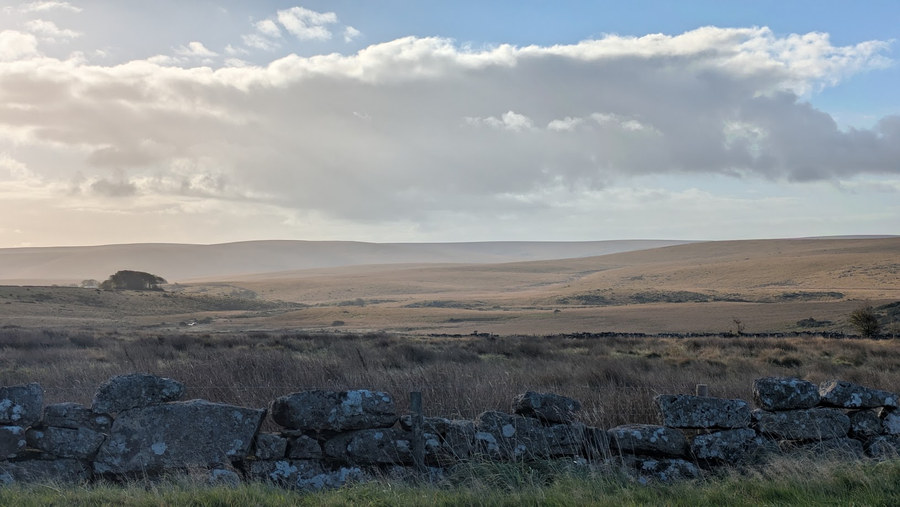
There are few better introductions to Dartmoor than a view across its open, seemingly empty uplands. Under the subdued October sky, the folds of the land recede into the distance, broken only by a stand of trees and a rough granite wall. Yet this landscape is anything but untouched. Its walls, field banks, settlements and industrial remains record many centuries of occupation and work.
Headland Warren: farming, rabbits and tin
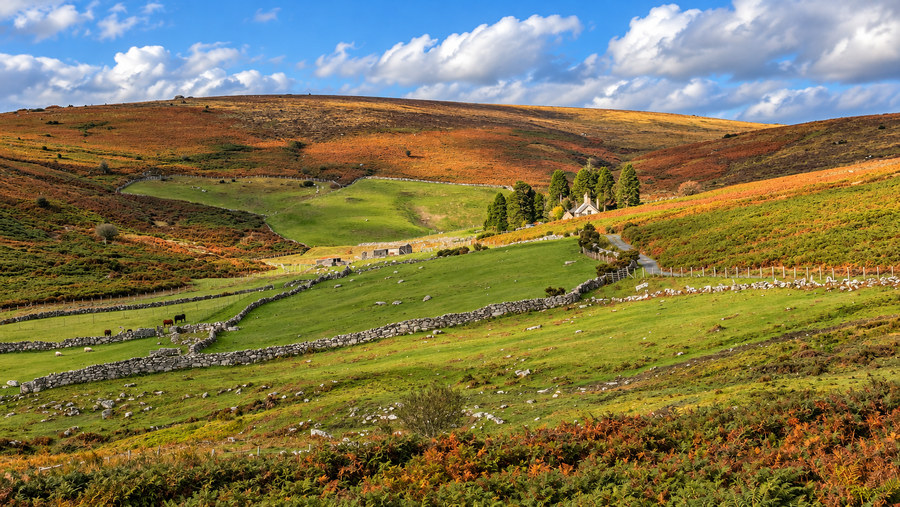
The country around Headland Warren contains evidence of several very different livelihoods. Farmers established settlements and fields here in the medieval period; rabbit warreners later managed the open ground; and tinners worked the mineral-bearing landscape. The remains do not all belong to one period. They overlap, sometimes obscuring and sometimes preserving one another.
Historic England records medieval longhouses and field systems in the wider Headland Warren archaeological complex. A longhouse commonly placed the living quarters at the upper end and the animals’ accommodation, or shippon, at the lower end. The rabbit warren was established before 1754 and continued until about 1920; its surviving traces include artificial breeding mounds, known as pillow mounds, and vermin traps. Tinworking left another set of marks: channels, pits, leats and the remains of later mines.
The medieval fields of Challacombe Down
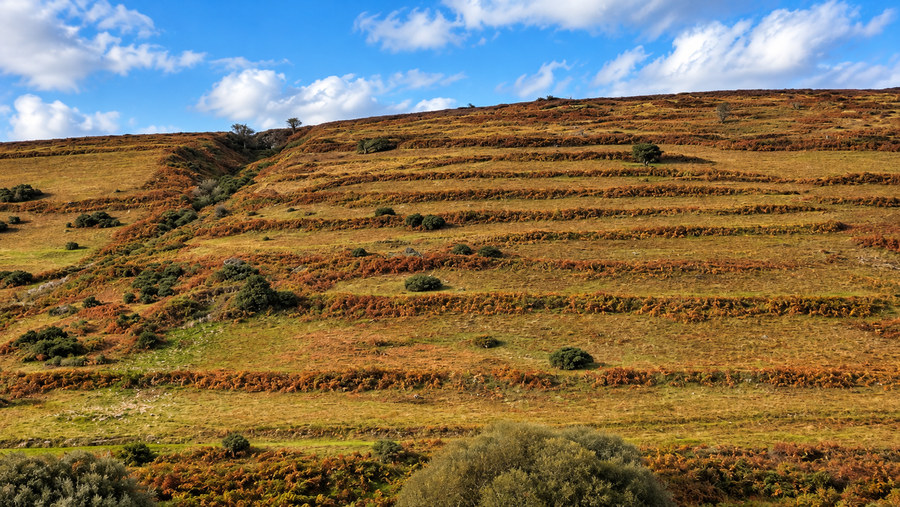
One of the most striking sights on the approach towards Grimspound is the pattern of nearly parallel strips running across the hillside. These are associated with the medieval field system of Challacombe Down, which Historic England describes as among the best-preserved examples of its kind in Devon and Cornwall.
The fields were laid out in narrow strips, many following the contours. On steeper ground, repeated cultivation and the movement of soil helped produce pronounced terrace-like edges called lynchets. Traces of ridge-and-furrow survive in some fields; others, too stony for regular ploughing, may have served principally as grazing land. The strips belonged to a working farming community, not to a single picturesque moment in the past.
Grimspound and a much older Dartmoor
Not far away lies Grimspound, one of Dartmoor’s best-known prehistoric settlements. Its massive enclosure wall surrounds the remains of at least 24 roundhouses, dating broadly to the later Bronze Age, around 1500–800 BC. The settlement lies between Hameldown and Hookney Tor. Excavations in the 1890s revealed hearths, paved floors, pottery and other evidence of domestic life, although some subsequent rebuilding has complicated the interpretation of what visitors see today.
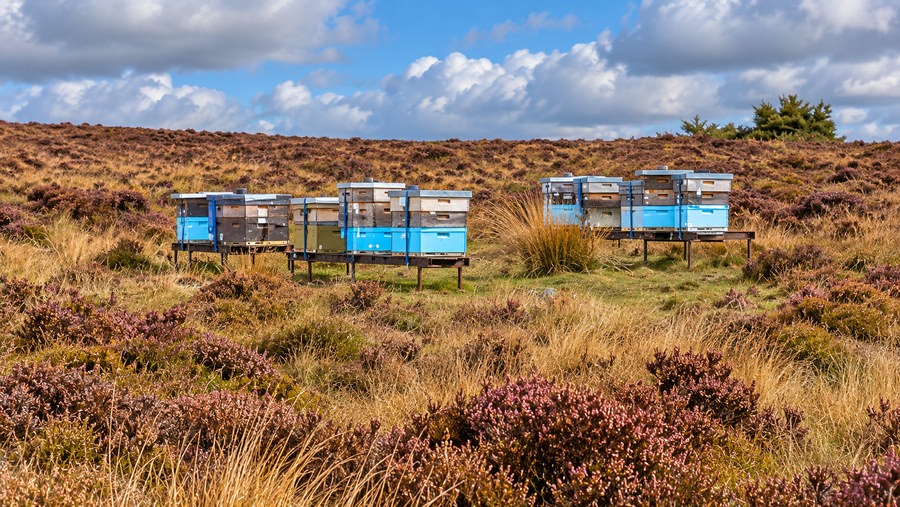
The medieval strips and the Bronze Age settlement should not be confused: they represent very different chapters in Dartmoor’s history, separated by more than two millennia. The nearby beehives add a modern chapter. They may be placed on the moor to exploit the heather nectar flow, though their precise management and purpose cannot be established from the photograph alone. Their blue paint and varied wooden construction make an arresting contrast with the surrounding brown autumn vegetation.
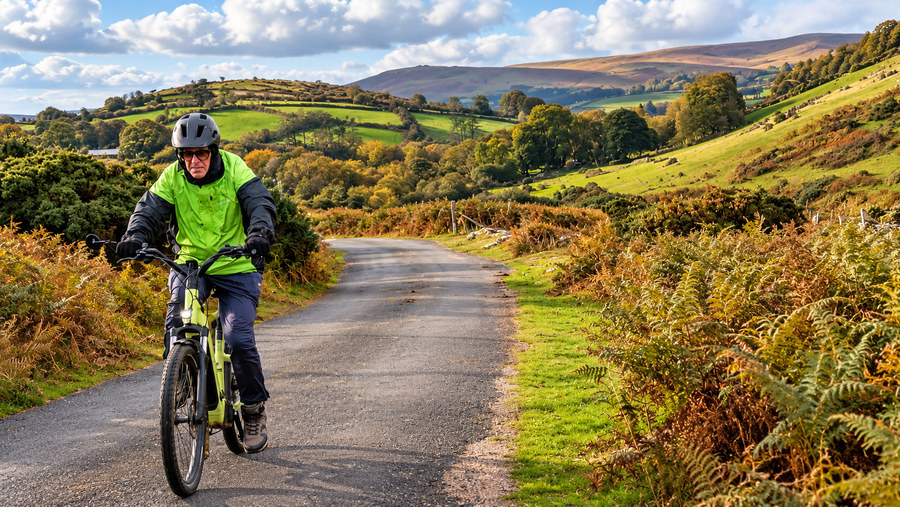
Thorn: a hamlet in granite and thatch
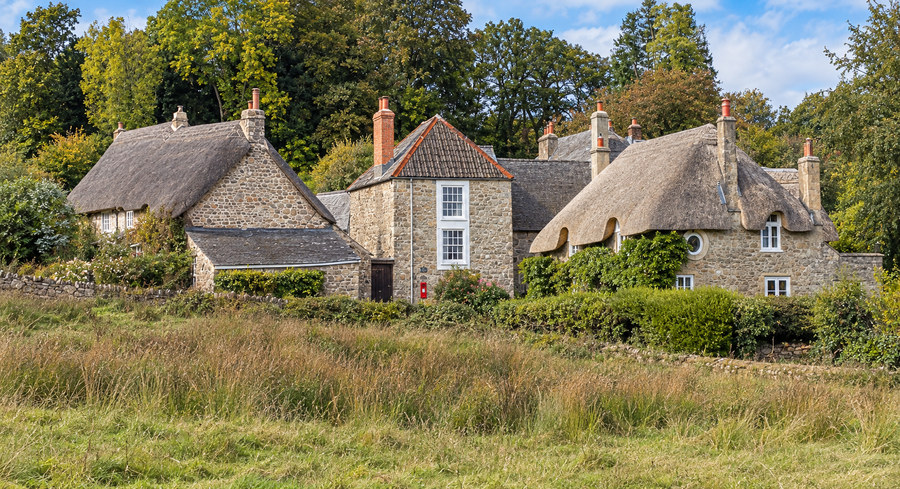
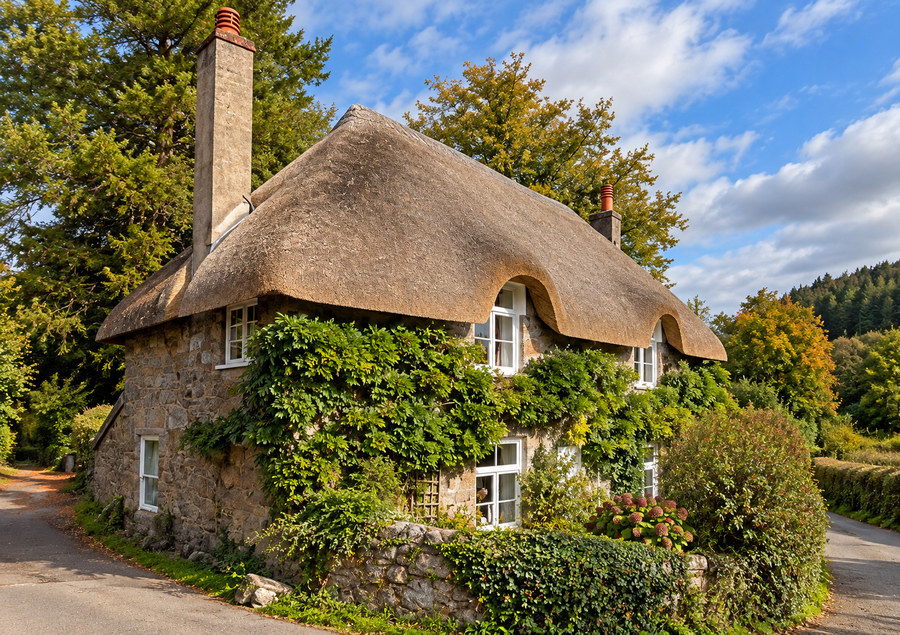
Thorn, near Chagford, is a small hamlet with a remarkable concentration of historic buildings. Its granite walls, thatched roofs and irregular arrangement reveal how buildings have been altered and reused rather than constructed all at once.
Historic England dates Thorn Farmhouse and Thorn Farm Cottage to the early sixteenth century, with substantial improvements in the later sixteenth and seventeenth centuries. A date-stone of 1687 may commemorate alterations to the floors and roof. The building began as a three-room farmhouse with a through-passage and was divided into separate homes in the twentieth century. Another listed building nearby began life as a seventeenth-century threshing barn and was converted into a dwelling around 1980. Thorn Cottage itself is listed as a later, nineteenth- or early-twentieth-century building.
The precise identity of the tall-chimney cottage in the photograph has not been independently confirmed; it is therefore captioned by location rather than assigned a potentially incorrect building name.
Chagford: tin, markets and a thriving town
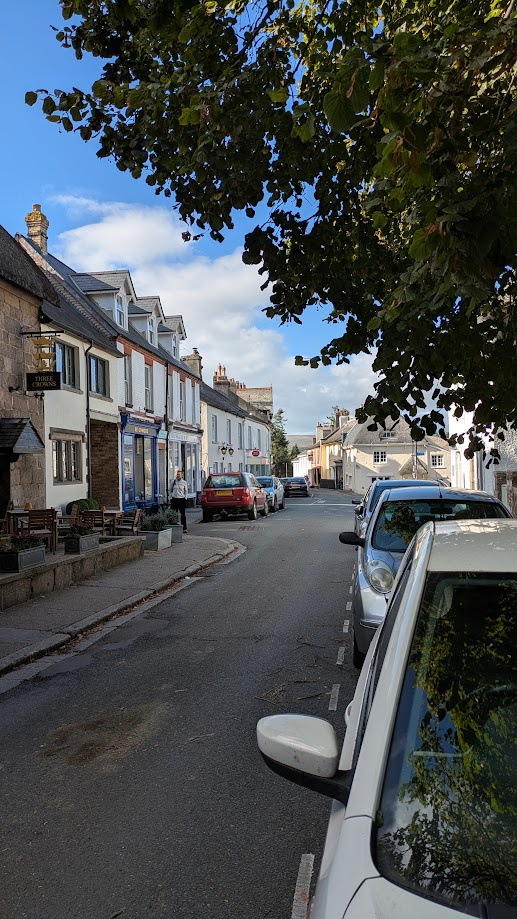
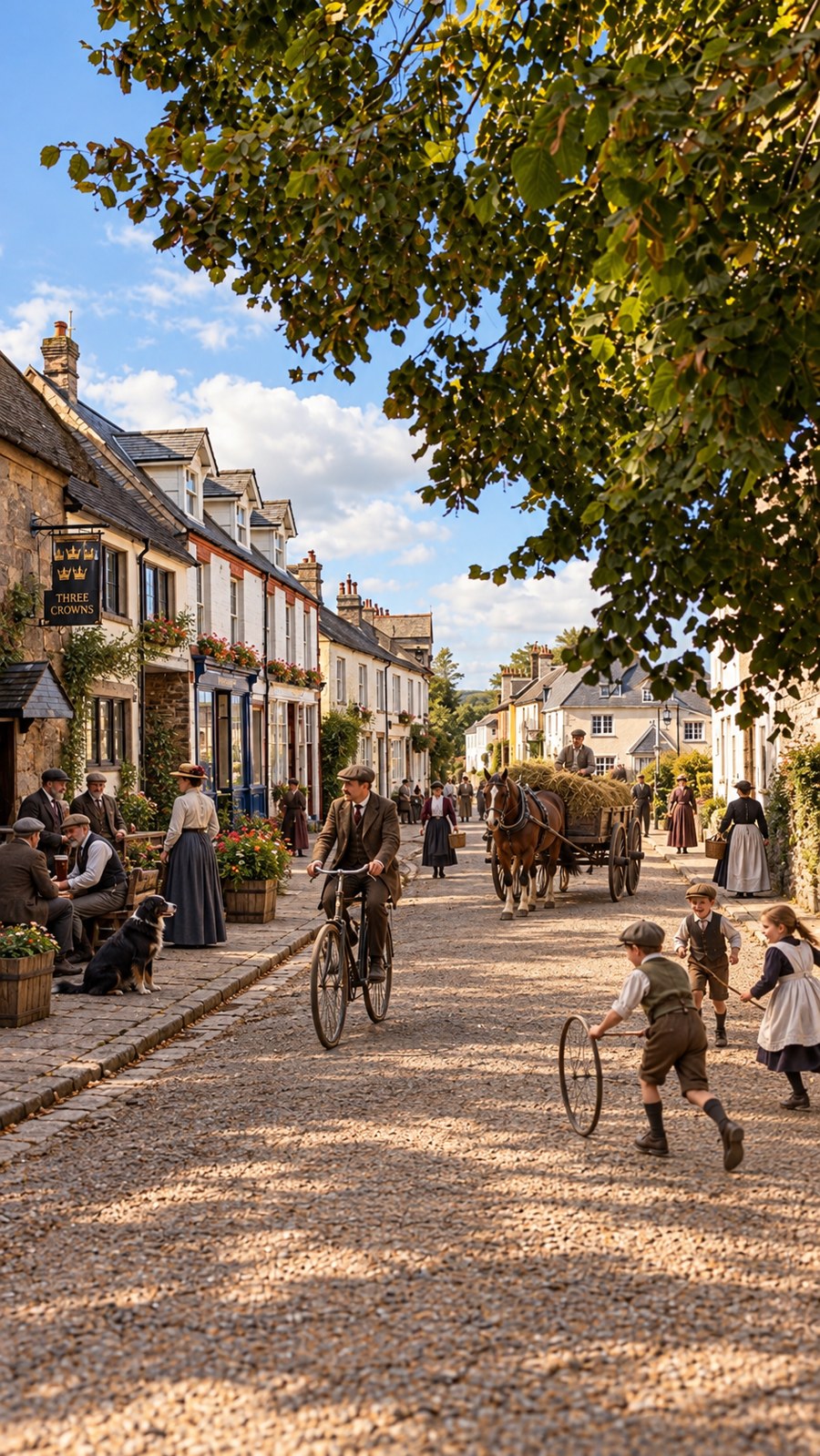
Chagford developed as a market town on the north-eastern edge of Dartmoor, above the River Teign. Its history is closely tied to the tin industry: in 1305 it became one of Devon’s stannary towns, where tin could be officially assessed and taxed. Trade in wool and agricultural produce also helped sustain the town, and in later centuries visitors were drawn to its moorland setting.
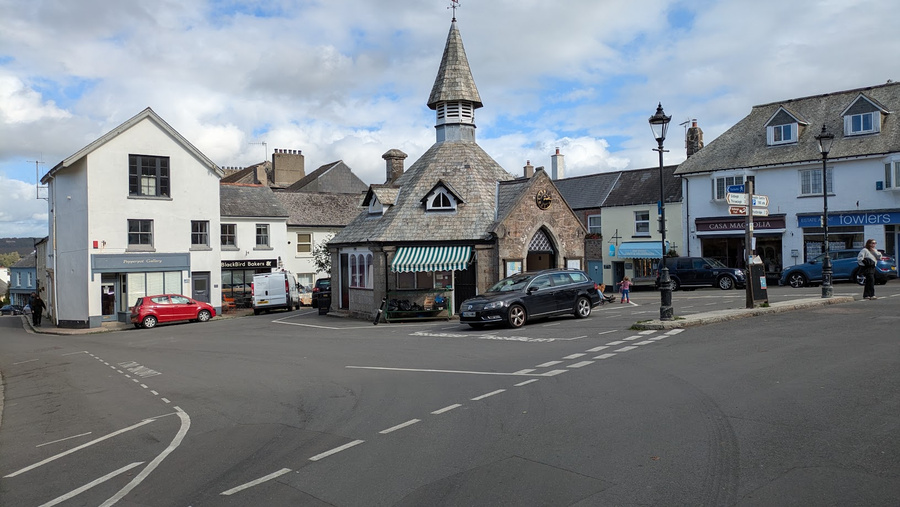
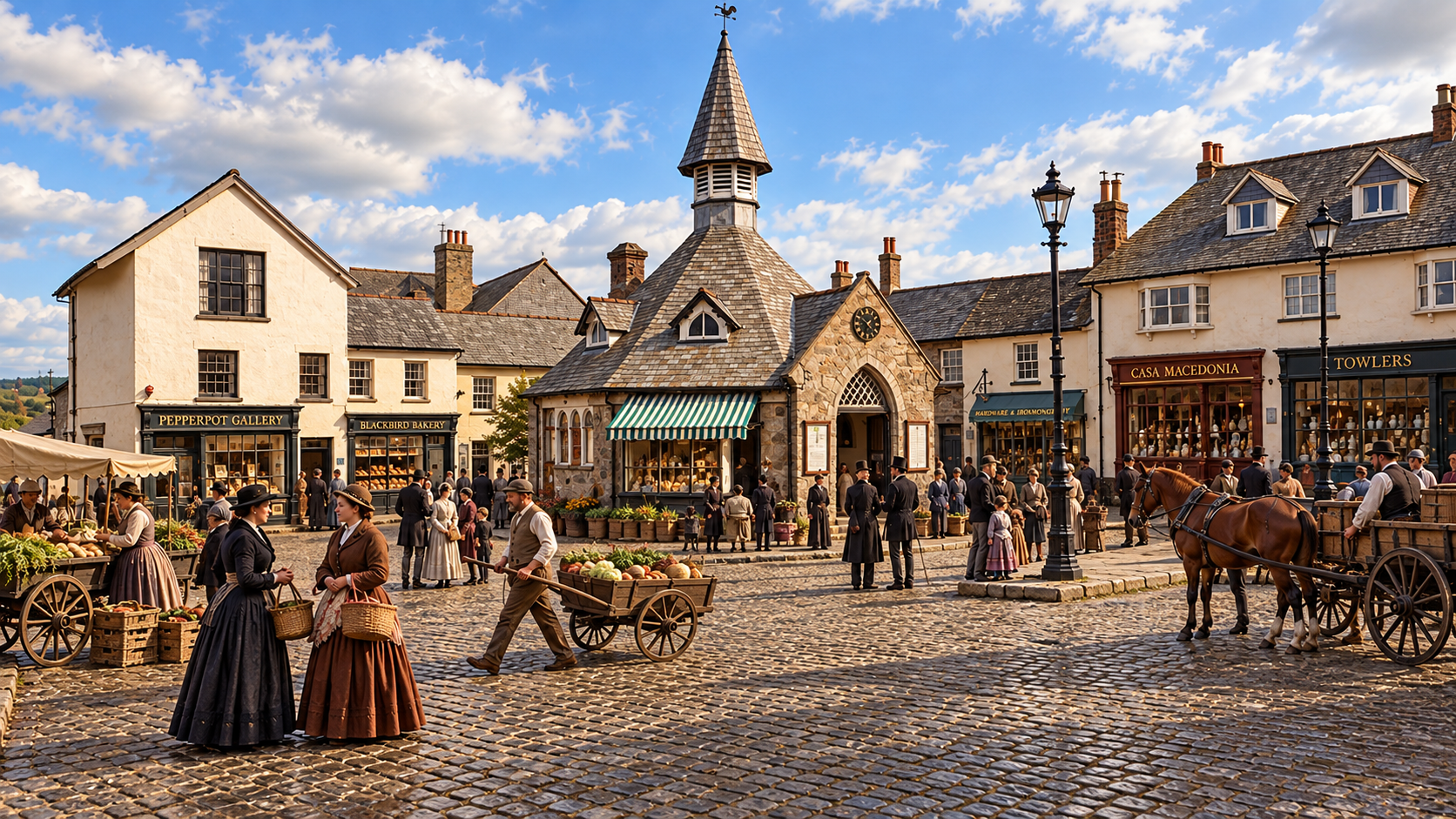
At the centre of Chagford stands the octagonal Market House, or Pepperpot, built in 1862 on the site of an earlier market and court house. The previous building, known as the Shambles, had fallen into disrepair. The present structure, with its pointed openings and slender spire, is a Victorian expression of a much older civic function.
The earlier market house also has a darker story. In 1617 part of the building collapsed while a stannary court was in session. Accounts differ over the number killed, but the event became part of the town’s historical memory. The replacement of the old Shambles in 1862 marked a new phase in Chagford’s commercial life.
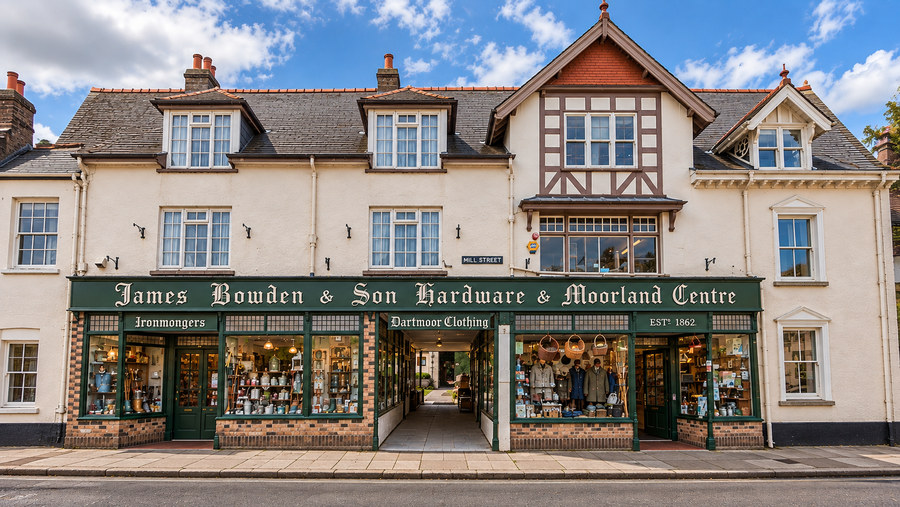
Chagford has retained the character of a town where shops serve a surrounding rural community as well as visitors. The shopfront of James Bowden & Son belongs naturally in a photographic record of the town: it is a reminder that local history is not confined to monuments. Everyday commerce, shopkeeping and the changing needs of farmers and households are part of the story too.
The church and the Three Crowns
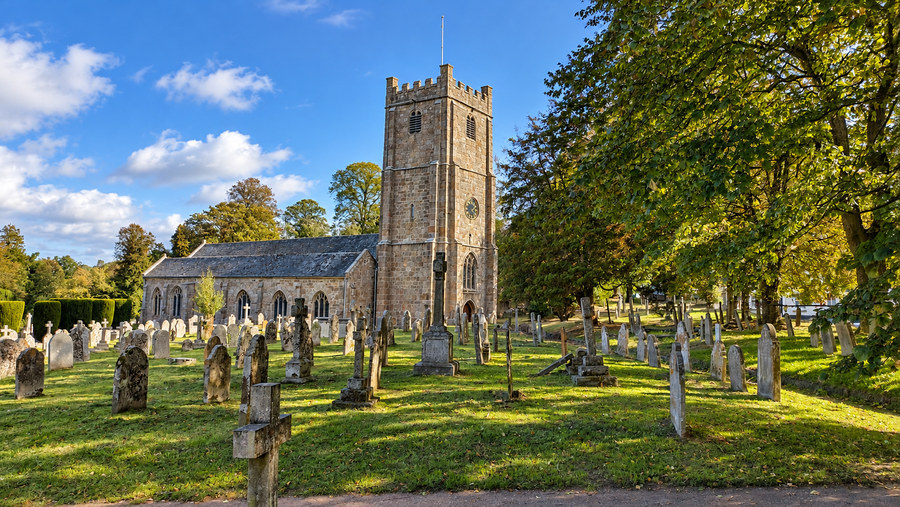
St Michael the Archangel’s Church is chiefly a fifteenth-century granite building, although parts of the fabric are older. It has long stood at the centre of the parish’s religious and communal life. Among its memorials is the gravestone of Mary Whiddon, associated with a well-known local tradition: that she was shot by a disappointed suitor after her wedding in 1641. The tale has sometimes been linked with R. D. Blackmore’s Lorna Doone, but the dramatic details should be treated as tradition rather than established fact.
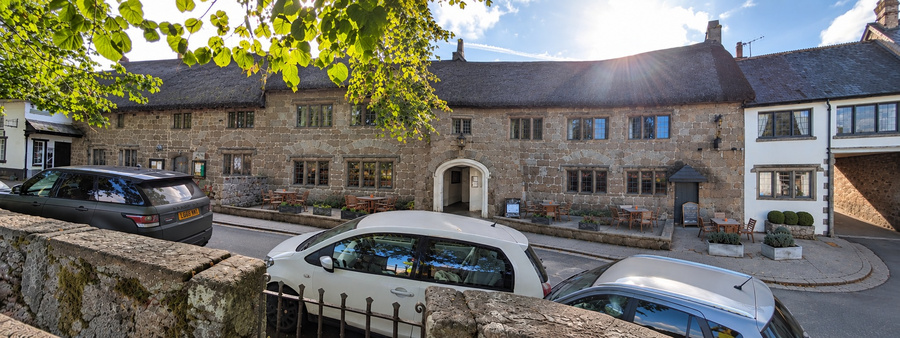
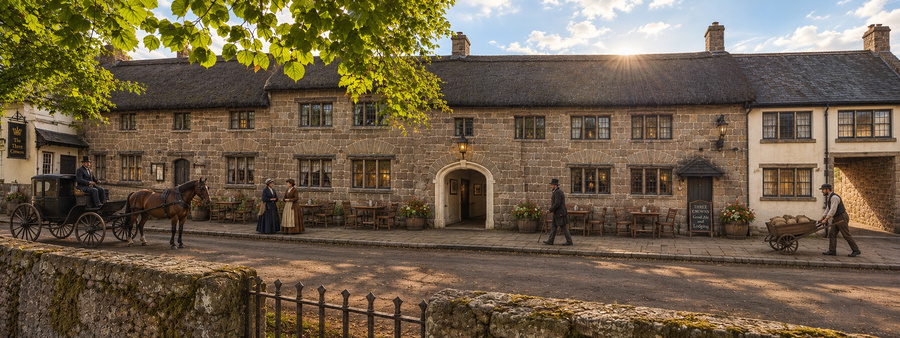
Close to the church stands the Three Crowns, one of Chagford’s most distinguished buildings. Its principal structure probably dates from the late sixteenth century and was altered in later centuries. It is traditionally associated with the Whiddon family and was once known as the Black Swan, a reference to the family crest. Historic England describes it as an inn that may originally have served as the dower house of Whiddonpark House. Its granite construction, old fireplaces and substantial roof timbers testify to its long life.
Layers of history in one ride
What made this excursion memorable was not simply the variety of scenery. Within a relatively short journey, the landscape offered evidence of Bronze Age settlement, medieval agriculture, rabbit farming, tin mining, historic rural housing and the development of a market town. The apparent emptiness of the moor and the busy streets of Chagford are two sides of the same story: people have shaped and reshaped this part of Devon for thousands of years.
Historical sources and further reading
Principal sources used for historical dates and descriptions:
- Historic England — Medieval strip field system on Challacombe Down
- Historic England — Headland Warren archaeological landscape
- English Heritage — History of Grimspound
- Historic England — Thorn Farmhouse and Thorn Farm Cottage
- Historic England — Thorn Cottage
- Historic England — Chagford Market House
- Chagford Local History Society — Market Square
- St Michael’s Church — Building and history
- Historic England — The Three Crowns
Photographs supplied from the ride. Some photographs have previously been digitally enhanced; the historical descriptions do not rely on reconstructed visual details. Image paths are relative to this HTML file.