Sydenham Damerel
Manor, mining, fire and reconstruction in the Tamar country
The lanes west of Tavistock pass through countryside whose present appearance gives little indication of the changes it has seen. Two places on this ride are particularly revealing: Bradstone Manor and the small parish of Sydenham Damerel. Between them they preserve evidence of landed wealth, medieval parish life, the Tamar Valley mining economy and the changing population of rural West Devon.
Bradstone Manor and the landed estate
At Bradstone the road approaches an extraordinary late-sixteenth-century gatehouse. Its battlements, pinnacles and granite-dressed entrance announce that this was once the centre of a considerable landed estate. Bradstone itself has a recorded history extending back before the Norman Conquest, while the surviving manor is principally sixteenth century.
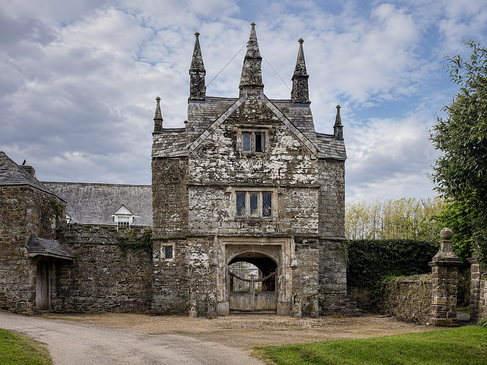
The estate became associated particularly with the Cloberry family. Much later it remained sufficiently substantial to comprise some 6,600 acres in the early twentieth century. The gateway is therefore more than an architectural curiosity. It is a surviving expression of the wealth and authority once exercised by landed families over the surrounding countryside.
St Mary’s, Sydenham Damerel
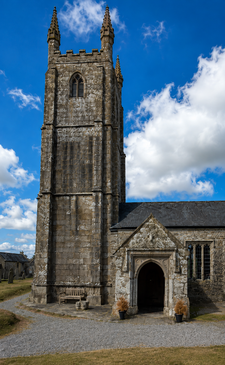
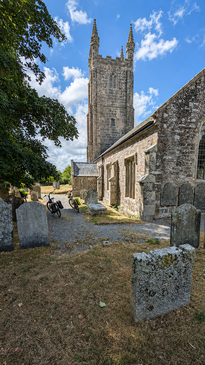
A few miles farther on, St Mary’s tells a very different story. The tower and porch survive from the fifteenth century, but much of what appears at first to be an ancient church is the result of a remarkable reconstruction following disaster.
The fire of 1955
In January 1955 the church was struck by lightning and gutted by fire. The surviving photograph of the ruined interior makes the scale of the destruction immediately apparent. Walls and windows remained, but the roof and much of the interior had gone.
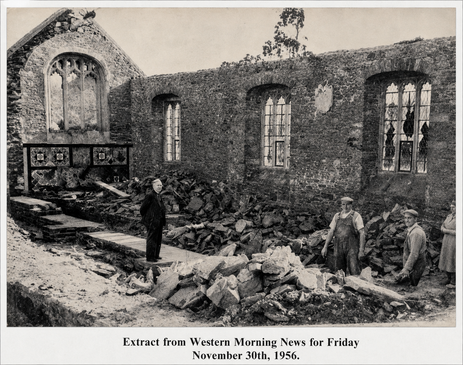
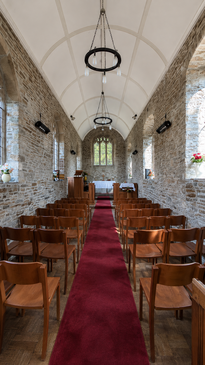
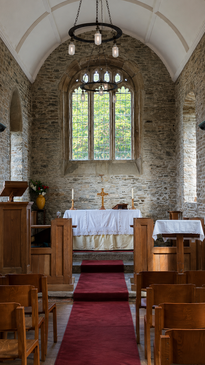
When rebuilding began, the parish did not simply reproduce the church as it had stood immediately before the fire. The north aisle, added when the local population was much larger, was not restored. Instead the building was returned approximately to its earlier medieval proportions. Surviving carved stonework and fifteenth-century windows were incorporated into the reconstructed church, and the barrel-vaulted roof was recreated in a form familiar from churches across Devon and Cornwall.
The reconstructed interior
The result is particularly striking inside. The simple nave, pale barrel-vaulted ceiling and exposed stone walls give the building an appearance of considerable age, although much of what the visitor sees is the product of the post-fire reconstruction. Medieval survivals and twentieth-century rebuilding now form a single interior.
Mining and a changing population
The decision to rebuild a smaller church reflected a much wider change in the parish. Sydenham Damerel’s population rose from about 199 in 1801 to 466 in 1851, before declining again to little more than 200 by the 1930s. Mining was an important part of that expansion.
Sydenham Damerel was an old agricultural parish rather than a settlement created around a single mine, but its inhabitants were drawn into the great Tamar Valley mining economy, with workings locally and across the river towards Kit Hill. As mining declined, so did the population. The church consequently preserves this demographic history in its fabric: an aisle needed by a larger nineteenth-century congregation disappeared when the building was reconstructed for the much smaller community of the 1950s.
Why “Sydenham Damerel”?
The parish reaches much farther back than the mining period. Sydenham is an English place-name, while Damerel derives from the Norman family associated with the manor by the thirteenth century. The name itself therefore preserves successive layers of settlement and lordship.
This was also a linguistically complex border country. Medieval English existed alongside the Anglo-Norman French of the landholding classes and the Latin of Church and administration, while Cornish continued to be spoken not far to the west. The modern county boundary conceals a region in which languages, people and economic connections repeatedly crossed the Tamar.
A royal connection
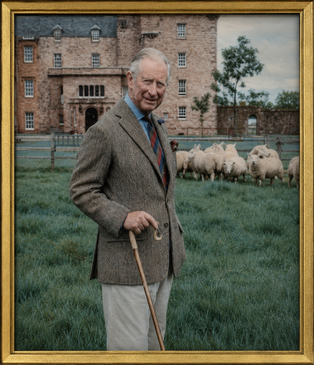
Inside the church are photographs of Charles, formerly Prince of Wales and now King Charles III, including an informal countryside portrait. The precise circumstances behind the parish display have not been established, so it would be unsafe to claim a particular visit or occasion from the photographs alone. Their presence nevertheless leads naturally to the wider history of the Duchy of Cornwall.
The Duchy of Cornwall
Charles was Duke of Cornwall from his accession as heir apparent in 1952 until becoming King in 2022. The Duchy is often misunderstood. It does not mean that the Duke owns Cornwall, and its lands are not confined to Cornwall. Edward III created the Duchy in 1337 to provide an income for his son and heir, and endowed it with lands and rights already under royal control, including property outside Cornwall. The present Duke of Cornwall is Prince William.
The Duchy differs in important respects from an ordinary private estate. Its landed capital is preserved for successive Dukes rather than being freely disposable as personal property. That institutional continuity helps explain why the Duchy has survived for nearly seven centuries while many private landed estates were divided, sold or diminished through inheritance, debt and taxation.
Several landscapes in one
The ride therefore crosses the remains of several different systems of power and influence: the landed estate centred on Bradstone Manor; the medieval parish represented by St Mary’s; the mining economy that transformed the Tamar country; and, still surviving in altered form, the Duchy of Cornwall.
None is immediately obvious from the lanes themselves. Yet manor gatehouse, church fabric, population history and the wider mining landscape all belong to the same countryside. Seen together, they explain why this apparently rural corner of West Devon contains evidence of such different periods and institutions.
Sources & Further Reading
- Historic England — Bradstone Manor and its listed gatehouse.
- Historic England — Church of St Mary, Sydenham Damerel.
- Parish material and contemporary photographs concerning the 1955 fire and subsequent reconstruction of St Mary’s.
- Historic population returns and census material for Sydenham Damerel.
- Cornwall and West Devon Mining Landscape — Tamar Valley mining history.
- Duchy of Cornwall — history and constitutional position of the Duchy.